Gifted, not yet talented. Using Psychology to explain why gifted people sometimes don't perform.
Updated: Aug 21
Experienced professionals can describe that moment of walking into a workspace and feeling that unmistakable spark of raw energy. It is the brilliant new hire who sees patterns others miss, the creative designer whose ideas overflow in every meeting, or the natural connector who instantly lifts the mood of a room. These individuals possess what we intuitively call high potential.
Yet, as many leaders discover, potential alone doesn’t automatically translate into long-term success. Brilliant minds can burn out, and creative visionaries can lose their way in the day-to-day grind.

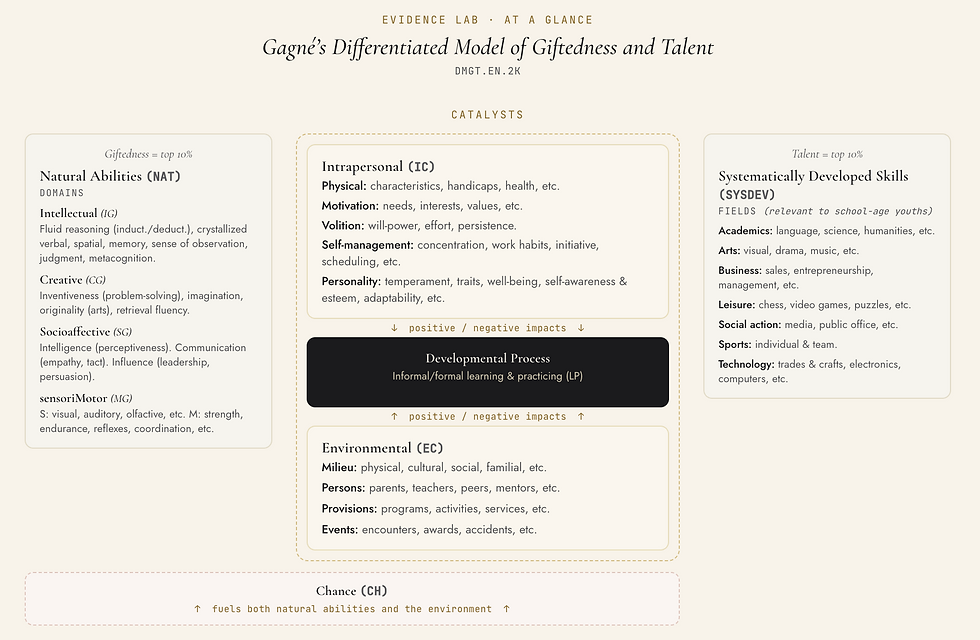
To understand how to truly support these individuals, we can turn to a framework from developmental psychology, which is Gagné’s Differentiated Model of Giftedness and Talent. When we view this model through the lens of positive psychology, it completely redefines how leaders can cultivate, mentor, and build thriving cultures at work.
Understanding the Beginnings of Giftedness
At the heart of Gagné’s model is a gentle but profound distinction between two concepts that are often mix up. Giftedness and Talent.
Giftedness represents a person’s natural, untrained abilities. These are the raw ingredients that someone is born with or develops naturally early in life. Gagné breaks these down into areas like intellectual clarity, creative fire, and deep empathy (socioaffective ease).
Talent, on the other hand, is the beautiful mastery of these gifts over time. It is a natural ability that has been shaped, practiced, and polished into real-world capability.
The Vulnerability of Raw Ability
It is easy to assume that highly intelligent or creative people are entirely self-sustaining. In truth, raw natural ability without a structured, supportive environment is highly vulnerable to frustration, self-doubt, and executive isolation.
In the world of work, raw ability is just the starting line. A team cannot launch a meaningful project or sustain a business on unguided potential alone. True impact happens when those raw, natural gifts are intentionally nurtured into mature, world-class talents.
Bridging the Gap of Development
The space between a natural gift and a developed talent is what Gagné calls the developmental process. This transition doesn't happen in a vacuum. It requires two incredibly powerful forces to act as catalysts:
1. The Internal Journey (Intrapersonal Catalysts)
This is a person’s inner world and it matters deeply. Natural brilliance needs the support of volition, which is simply the heart, grit, and daily habits required to keep going when the initial novelty of a project wears off. Positive psychology reminds us that true motivation comes from within. When people feel a sense of autonomy and believe in their own growth, they naturally find the resilience to turn their raw sparks into steady, enduring flames.
2. A Nurturing Workspace (Environmental Catalysts)
This is where leadership becomes an art form. All too often, corporate development focuses on a deficit-reduction model, which is finding what an employee is bad at and spending all their energy trying to fix it.
Constantly forcing a gifted professional to focus on their flaws chips away at their confidence and sense of self. It shifts their focus from creative exploration to defensive self-protection.
When leaders embrace a strength-based approach, they invest in what makes the person extraordinary instead of obsessing over their minor gaps. By providing tailored mentorship, meaningful challenges, and an environment where it is safe to try and fail, leaders provide the exact psychological nutrients needed for a gift to grow into an impactful talent.
Compounding Capability Through Exposure
To bridge the gap, leadership must transcend the passive curation of training rooms and operationalise a dual mandate, which is the engineering of both developmental runways and opportunities to showcase talents. According to the Dreyfus Model of Skill Acquisition, transitioning from a competent practitioner to an expert requires increasingly ill-structured, high-stakes operational environments.
If a Leader within an organisation provides the resources to develop a gift in isolation but fails to deliberately engineer the platform for that asset to showcase its mastery to the market or the board, the talent undergoes developmental atrophy. The person internalises a sense of institutional irrelevance, which directly fractures their core need for competence under Self-Determination Theory.
True environmental catalysis requires leaders to first build the hidden runway, which is the psychological safety to iterate, fail, and deconstruct complex problems without commercial penalty, and then actively design the theatre of execution.
This means handing high-potential people the floor at critical board reviews, or assigning them the mandate for high-stakes client turnarounds.
By intentionally orchestrating the chance to both sharpen the tool and swing it in full view of the enterprise, leaders convert fragile potential into verified, market-shaping capital.
Combining Talent with Heart
When an organisation successfully bridges this gap, they don't just build a highly efficient employee. They cultivate a truly inspiring leader. However, technical talent alone can sometimes feel cold or intimidating if it isn't anchored by a genuine care for people.
The ultimate goal of leadership development is pairing mature Talent with Warmth.
When a highly talented person genuinely practices warmth and accessibility, it triggers a ripple effect across the entire team. It dissolves the intimidation factor, unlocking psychological safety and allowing others to speak up and innovate without fear.
When domain mastery is wrapped in deep human empathy, a leader becomes an anchor for their team. They don't just execute projects beautifully. They listen deeply, build trust effortlessly, and guide their businesses through complex challenges with grace and calm composure.
A Modern Invitation for Leaders
Take a moment to look at your team members this week. Shift your gaze away from their minor administrative blind spots or small development gaps. Instead, look closely for their raw, natural sparks. Their unique intellectual curiosities, their creative instincts, or their natural warmth.
Commit your energy, your on-ground coaching, and your focus to investing in those strengths. When you cultivate the gift rather than managing the deficit, you don't just optimise a workforce. You create a workspace where human potential truly flourishes.
It's food for thought.